I have been working on building hardware to support two scrapers (dirt pans) and three rovers (tractor and two scrapers) and that can be found here: Opengrade3D With Two Scrapers
I created a set of C# classes to communicate with my custom hardware (Opengrade3D With Two Scrapers - #65 by andya) and started looking at how to integrate them into OpenGrade3D.
After thinking about this for a while I have decided to write my own application instead of using OpenGrade3D. This will be GPL3 and I will use the 3D graphics parts from either AgOpenGPS or OpenGrade3D. I came to the conclusion that this will end up being less work overall than trying to adapt OpenGrade3D into what I want.
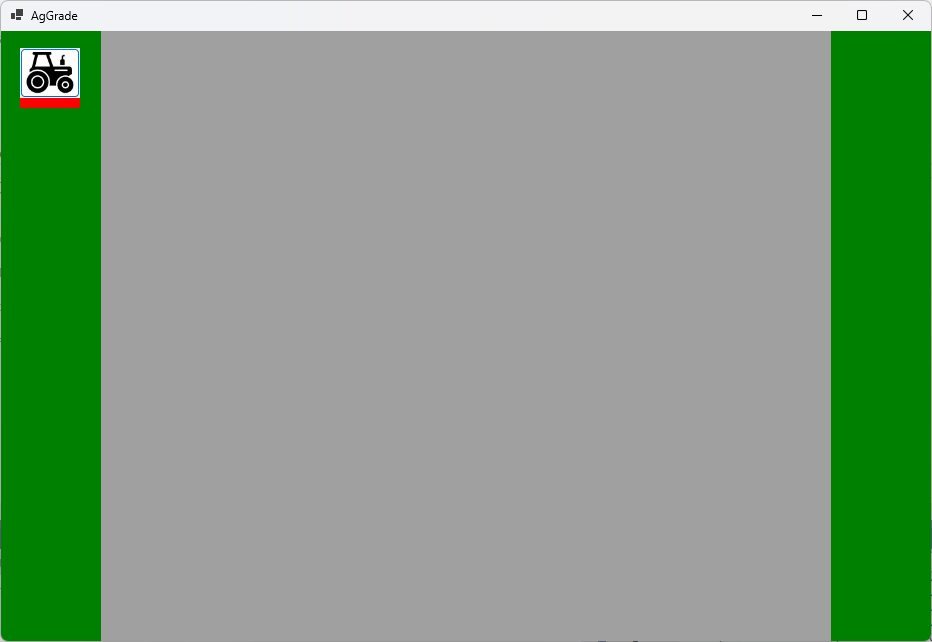
I will document it as I go along. Here it is so far after an hour of work.
What is the key benefit of the 3D view over a 2D top view? Sure it looks nice but does it really add anything important to the functionality? I am thinking for the topology and cut/fill view it will be more useful for a 2D view that can be zoomed in and out.
Another thing I would recomend is making your software UDP compatable like AOG is. Current Open Grade only has serial and UDP seems a lot more reliable connection. Maybe use the AgIO from AOG?
That would require a redesign of my hardware. I have a USB hub integrated onto my board. What are the USB reliability problems people are seeing specifically? Is it the USB connectors struggle with vibration?
Regading the AgIO board - it won’t work for my needs. I need three rovers, three IMUs, two angle sensors and control of two valves.
Hmmm… Well looking at my hardware design it would be possible to create an adapter board that converts Teensy 4.0 to Teensy 4.1 to give Ethernet. Fortunately I made the three rover outputs available on a connector so with a cable they can be supplied to the adapter board. That would allow me to switch to Ethernet and combine rovers and CAN bus data into a single connection to the tablet.
However my Panasonic FZ-G1 doesn’t have Ethernet so I would need to get the adapter.
I would have to abandon the idea of a slave tablet, but I am thinking I don’t need it anyway.
Then again I could make the adapter board support two teensy 4.1s to provide two ethernet connections (one for each tablet) and allow the Teensys to talk to each other to create a communications channel between the tablets. Hmmm…
My original thinking was to use two tablets to show two different map views at the same time.
High vibration environments are the main issue I believe. But a serial does not auto reconnect whereas it seems UDP in AgOpen always looks and finds. I don’t know, it just seems like whether its USB, or a docking station with serial DB9 it causes issues.
I think my mind is made up - I will design an adapter board to convert from USB to UDP, as I need as much reliability as possible. I can’t afford to be stopping and starting in the middle of leveling a 40ac field because it increases the risk of getting caught with rain.
I will post the design and updates on my “two scrapers” hardware thread.
Status bar has LEDs to indicate the status of the connection to the controller, the rover RTKs, the IMUs and the height sensors. If the front and/or rear scraper is not equipped then the LED is disabled.
Here the connection to the controller is good but the tractor rover does not have RTK and the tractor IMU is not reporting data. The scrapers are not equipped.
Subbed, if you’re still in design stages I would love to see something that works with my pull grader. I thought BlackAce’s project had that potential but not sure he’s working on it anymore.
Pull grader has separate hydraulics for the left and right side of the blade so you can cut angles etc, so these would have a GPS antenna on each side. Quadtrac should be able to control both independently via 1-3 switch.
Yup correct. I’m just saying I’d love to get an open source project with dual GPS. I don’t think you need to do anything special for the grader since its effectively just tandem scrapers side by side instead of in a row, but I’ll explain the process anyway.
I use a quadtrac which does machine control through hydraulics 1 and 3. Controlled via a 4-pin connector under the cab…something about reference voltage (discussed in I think the OpenGradeX thread). Currently we run Field Level 2 in point and slope mode, but only have the single unit unlock. Dual unlock is $$$$ hence my interest in a dual gps open source program.
When running scrapers in dual setup, you put a gps receiver over each cutting edge and drag them in tandem, and each one targets a cut depth based on its own given location. Pretty straightforward. The grader is no different, just instead of being 40 ft apart and in line, its 16 ft apart and side-by-side. So as long as direction of travel doesn’t play into the machine control algorithm I don’t think there would be any difference in scrapers vs grader?
The problem I do have - FL2 doesn’t have a max cut depth option. So if the cut program takes me through a high spot, say 4’, its gonna push that blade all the way down trying to reach that depth…which usually means cutting a big gouge, bogging the tractor out, and throwing the wheels way up in the air and almost tipping itself over. Makes a mess!
So I guess since you’re already attempting a dual scraper setup, the only thing I’m here to request would be a max cut depth option. Survey the pass, break it into a series of cuts X inches deep like a layer cake, and let the user decide when its time to jump to the next layer. Fairly certain this is standard in drainage programs but FL2 does not have it…
OK - good news - I need the max depth too. With the scrapers I can only cut about 0.2 ft at a time otherwise I will bog down the tractor.
Do you need an analog signal or PWM? If you need analog then you would need an external DAC board to plug into the blade control connector on the circuit board, instead of the Cytron that I am using.
What is your input file format or how do you enter the slope details into your current system?